
Retirement Planning Is Broken
Why Longer Lives Require the Next Evolution of Financial Advice
By bQuest
Executive Summary
Retirement planning has spent decades becoming more sophisticated at answering one question: Will the client run out of money? But that focus has created two profound blind spots.
The first is that many retirees are so uncertain about what they can safely spend that they chronically underspend, sacrificing experiences, generosity, and quality of life because the plan never gave them confidence to use what they had built. The second is that the costs most capable of disrupting the plan, particularly healthcare and long-term care, do not behave like ordinary retirement expenses. They are episodic, unpredictable in timing, and potentially catastrophic in scale.
A financial plan that cannot give clients confidence to use their resources, or responsibly prepare them for the events most likely to disrupt those resources, is not fully solving the problem it was designed to solve. The problem is not that the conventional retirement plan is wrong. It is that it was designed for a shorter, simpler version of later life than the one most clients will actually live.
The urgency to evolve has never been greater. By 2030, every member of the Baby Boomer generation will be age 65 or older, and one in every five Americans will be of retirement age. The financial advisory profession has spent decades helping this generation accumulate and preserve wealth. The next era of financial advice will be def ined by helping that same generation use its wealth to live well across the years ahead.
Historically, the profession evolved when client needs outgrew the existing model. Investment Planning expanded into Financial Planning, and comprehensive advice later incorporated Estate Planning and Tax Planning. Each evolution broadened the advisor’s field of view to account for forces that materially shaped a client’s financial life.
The next evolution is Longevity Planning. Longevity Planning expands the planning lens from Will the money last? to a larger question: What will need to change in the client’s resources and support system to sustain the full arc of a longer life?
Planning, however, is only part of the answer.
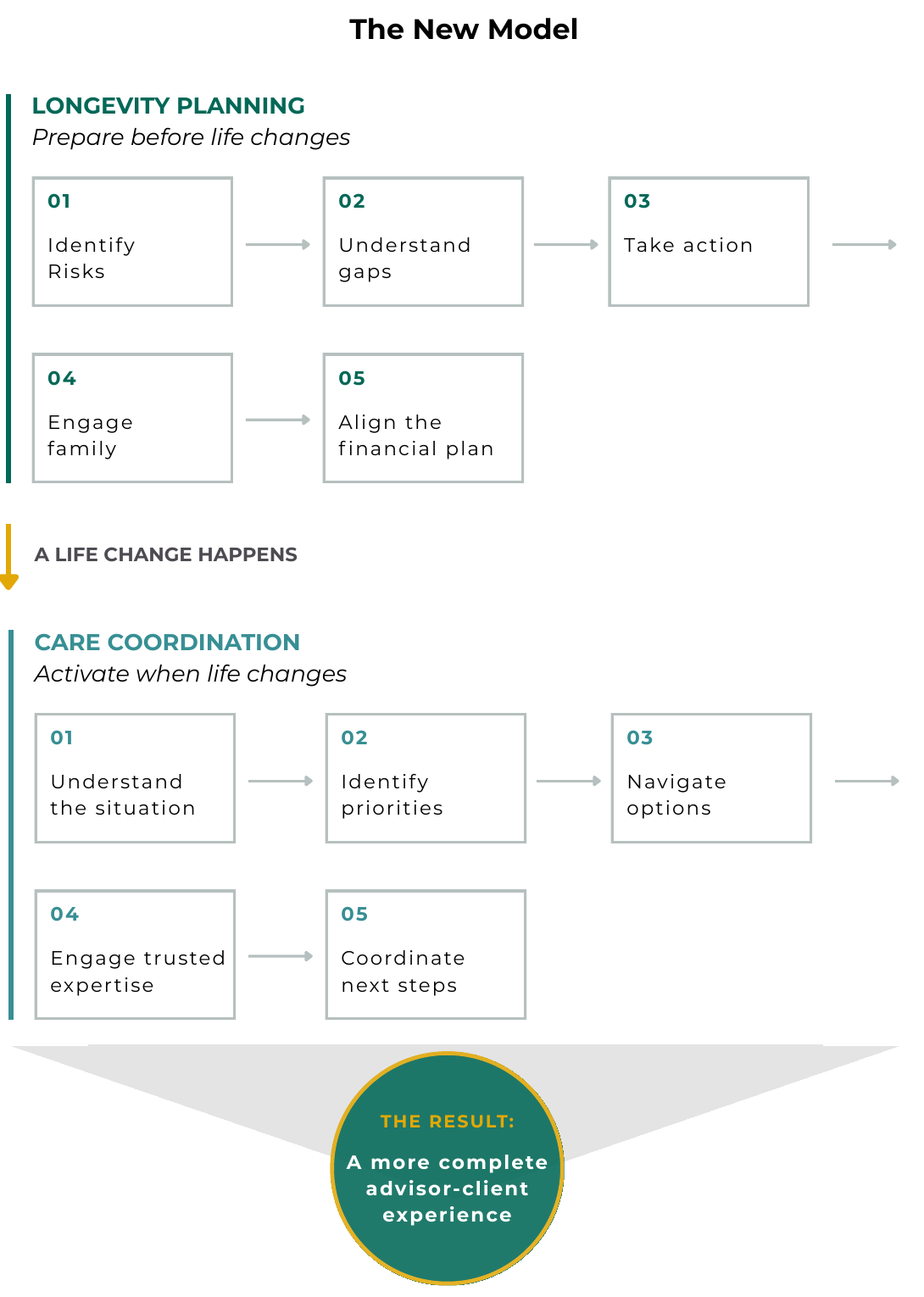
When a diagnosis arrives, a parent is discharged from the hospital, a spouse begins showing signs of dementia, or a family suddenly needs to make difficult decisions, clients need more than a plan. They need help navigating experiences that are complex, confusing, and emotional. That is the role of Care Coordination: the just-in-time support mechanism that activates when life changes.
Together, Longevity Planning and Care Coordination create a more complete model for comprehensive advice. What has been missing is the infrastructure to deliver both through the trusted financial advisor.
The Current Model’s Key Blind Spots
Russ Hill, former CEO of Halbert Hargrove and author of Optimizing Longevity, identifies a paradox at the hear t of conventional retirement planning. Many retirees end up with more money at death than they had at retirement, not because that was their intention, but because they were af raid to spend.
For decades, retirement planning has focused on minimizing the risk of running out of money. Advisors model market returns, inflation, withdrawal rates, taxes, Social Security, and sequence risk, then produce a probability that the portfolio will sur vive to a predetermined age. The process may conclude that a client has an 85 or 90 percent probability of success.
But does that give the client confidence to act? Can they take the family on a meaningful trip, help a child or grandchild today, give to the people and causes that matter to them, or spend more while they are healthy enough to enjoy it? For many clients, a probability of success does not feel like permission.
The result is what Hill calls the consumption paradox, which is a model designed to protect clients from running out of money, which can leave them so focused on preservation that they fail to use their resources to support the life they actually want to live. A successful plan should do more than protect against financial ruin. It should give clients the confidence to spend, to give, and to live.
Hill’s work explored more dynamic ways to help clients understand their financial position.
The specific methodology is less important here than the underlying insight, which is that clients need to understand the longevity risks that could change the plan, take action against the risks they can offset, insure against, or provide reserves, and then confidently use their remaining resources to support the life they want to live.
That is where the current model begins to break down, because some of the largest potential claims against the financial plan are also the ones the industry understands least. Healthcare and long-term care costs do not behave like ordinary retirement spending. They are episodic, unpredictable in timing, and potentially catastrophic in scale.
A client may live independently for decades and then suddenly require home care, major home modifications, assisted living, memory care, or round-the - clock support. A diagnosis may trigger years of specialist care, family caregiving, transportation needs, housing decisions, and legal complexity. One spouse may remain healthy while the other requires intensive support. An adult child may reduce work, leave a job, travel frequently, or absorb expenses to provide care.
Yet many financial plans ignore these spending needs, underfund them, or reduce them to a generic line item disconnected from the client’s actual health, family structure, housing, geography, preferences, and available support. Which raises a fundamental question: How can an advisor build a responsible financial model without understanding the likely care needs the client’s assets may ultimately be required to fund?
The industry models inflation, taxes, market returns, withdrawal rates, and sequence risk. But how often does the planning process meaningfully examine where the client intends to live, who is likely to provide care, whether family is willing and able to help, how cognitive decline could affect decision-making, or what happens financially if a spouse or adult child becomes a caregiver? Care is not adjacent to the financial plan. It is one of the largest potential claims against it.
The Map Has Changed, Yet the Planning Model Has Not.
The year 2030 marks a historic demographic turning point. By then, every member of the Baby Boomer generation will be age 65 or older, and one in every five Americans will be of retirement age. A generation of approximately 73 million people is moving into the years when the realities of longevity become increasingly consequential.
The Stanford Center on Longevity’s New Map of Life initiative has spent years examining the implications of longer lives and the need to redesign institutions and systems built for a prior era’s lifespan. For financial advisors, the implications are immediate.
Millions more clients will be navigating longer retirements, changing health, caregiving responsibilities, housing decisions, cognitive risk, family involvement, and care needs whose timing and cost are difficult to predict. Ken Dychtwald, founder and CEO of Age Wave, has described this transformation as a longevity revolution, one so significant that the systems built around aging have struggled to keep pace.
The financial advisory profession has spent decades helping the Baby Boomer generation accumulate and preserve wealth. As a result, the next era of financial advice will be def ined by helping that same generation use its wealth to live well across the years ahead.
Particularly, as affluent clients have more options: more specialists, more treatments, more housing choices, more technology, and more paid support. What they do not necessarily have is someone holding the full picture.
Tom West, a long-term care planning specialist whose work supporting advisors and families at SEIA has informed his writing through Age Against the Machine, has documented this dynamic in practice. In one case, West describes a couple with a $25 million net worth who had assembled an extensive healthcare ecosystem involving multiple specialists and experimental therapies. But the system was fragmented. When West asked who had the full picture, the room went silent. No one did.
More money buys more access. It does not automatically determine who makes decisions, who understands the complete picture, who knows what the client wants, or how the medical, financial, housing, legal, and family pieces fit together. The care coordination problem is universal. Wealth changes the range of available options, but it does not eliminate the complexity of navigating them. In some cases, it compounds it.
For example, what happens when the client can no longer execute the plan? Every financial plan depends on execution. Yet conventional planning often assumes that the client who helped create the plan will remain capable of understanding and acting on it. That assumption becomes increasingly fragile across a long life.
As a result, cognitive change is not simply a health issue, it now becomes a planning issue.
Who notices first? Who steps in? Who is authorized to act? Does the family know what the client wants? Do the people named in legal documents understand their roles? What happens when the client can still make some decisions, but not others?
Tom West also writes about emotional timing, which is the recognition that even technically excellent advice can fail when a client lacks the cognitive or emotional bandwidth to absorb it. He captures the problem in the story of a woman caring for her husband with dementia. After walking her through a financial plan, West asked what she had been thinking while he spoke.
“The only thing I was thinking about when you were talking was that I forgot that my one goal that morning was remembering to eat lunch. I forgot to eat lunch. And you were still talking.”
The lesson is profound. Planning is not simply information transfer. It is timing, receptivity, and trust. A technically correct recommendation delivered at the wrong moment may be functionally useless. As a result, a financial plan is only as good as the client and their family’s ability to execute it when life becomes difficult.
That means advisors also need to understand who surrounds the client. Who will step in during a crisis? Who will help evaluate care or housing options? Who holds legal authority? Who will ultimately help execute the plan? These questions should be answered before the family is under pressure. They also create a powerful opportunity for advisors to build meaningful relationships with the people who may eventually become central to the client’s life.
An adult child helping a parent navigate a dementia diagnosis may have had little prior interaction with the family’s financial advisor. But when that advisor can do more than express concern, when the advisor can connect the family to trusted expertise, help them understand what needs to happen next, or deliver a tangible solution during one of the most difficult moments of their lives, the relationship changes. The advisor has an opportunity to surprise and delight the larger family at precisely the moment they least expect a financial advisor to be able to help. That is not simply next-generation marketing. It is earned trust.
The Stanford Center on Longevity’s work reaches a similar conclusion from the research side. The institutions built around human life were designed for a prior era’s lifespan and must evolve for a world of longer lives.
For financial advisors, this is not an abstract societal question. It translates directly into the planning process. What does the client’s health and family history suggest about future needs? Is the home suitable for the life the client says they want to live? Who will provide support if care is needed? Does the family have a decision-making structure in place? Who has the information and authority to act?
And critically, how could a care need change the financial plan not only for the client, but for a spouse or adult child who steps in to help? These are not questions that belong solely to physicians, social workers, attorneys, or care professionals. They belong in the financial plan because the financial plan will ultimately be required to support the answers.
The financial industry has become extraordinarily good at helping clients accumulate resources and protecting those resources from running out. But a longer life requires a more ambitious goal which is helping clients use their resources to live well across the full arc of life.
The Return on Empathy
The moments that most profoundly shape a client’s life are often not investment moments. A parent begins to decline. A spouse receives a diagnosis. A client becomes a caregiver. A family realizes the home no longer works. An adult child is pulled into a crisis. A spouse dies. The financial consequences may be significant, but the client’s immediate question is rarely about the portfolio.
Frank McAleer spent years building and supporting vetted longevity resource networks for financial advisors at Raymond James and currently Key Financial, Inc. Those networks included Medicare specialists, elder law attorneys, caregiving agencies, fraud protection services, digital legacy platforms, and other resources designed to extend the support advisors could provide.
Among advisors who used the networks, McAleer saw client engagement rates of 20 to 25 percent and consistently strong feedback. A Medicare guidance partnership alone eventually grew into a seven-figure revenue relationship. The resources worked; the challenge was making them easy to use. Building, vetting, maintaining, and activating a resource network required significant effor t. Without centralized infrastructure, adoption depended too heavily on the individual advisor.
McAleer describes the value created by advisors who did engage as a return on empathy. They did not build these capabilities primarily as a business development strategy.
They did it because they cared about their clients’ full lives and the business results followed.
Advisors who help clients navigate the realities of longer life become relevant in a fundamentally different way. They become the person who helped the family prepare, the person who knew where to turn, and the person who made a difficult moment less over whelming. That kind of value is difficult to commoditize, and difficult to replace. The value begins with better client service, but better client service can create meaningful business results.
• Organic Growth. Longevity conversations uncover needs that rarely surface through traditional financial discovery, creating opportunities for deeper planning, broader relationships, and new client introductions.
• Retention. A relationship built around understanding and supporting the client’s full life extends beyond traditional client engagements.
• Next-Generation Engagement. Aging and caregiving events naturally bring generations together. Adult children meet the advisor not through a marketing campaign, but through the experience of being genuinely helped when their family needs it.
• Differentiation. Most firms say they provide comprehensive planning. Few have a structured, repeatable way to help clients prepare for the realities of aging and navigate them when they arrive.
• Risk Mitigation and Advisor Capacity. A trusted support infrastructure allows advisors to remain involved without drifting beyond their expertise, spending hours researching providers, or becoming the family’s care coordinator.
• Asset Continuity. When the next generation experiences the advisor as someone who supported the family through a difficult chapter, the relationship begins from a very different place.
The opportunity is to become the trusted professional who recognizes what is coming, helps clients prepare for it, and ensures they know where to turn when it arrives.
The Next Evolution of Financial Advice
The financial advisory profession has never stood still. It has evolved each time clients needed more than the existing model could provide. Investment Planning began with the portfolio. Financial Planning connected the portfolio to the client’s broader financial life and goals. Estate Planning extended the conversation to wealth transfer and decision-making across generations. Tax Planning addressed how clients could use and transfer their resources more eff iciently.
Each evolution expanded the advisor’s field of view. And each was driven by the same realization which is you cannot provide truly comprehensive advice while ignoring a major force shaping the client’s financial life.
That next evolution is Longevity Planning.
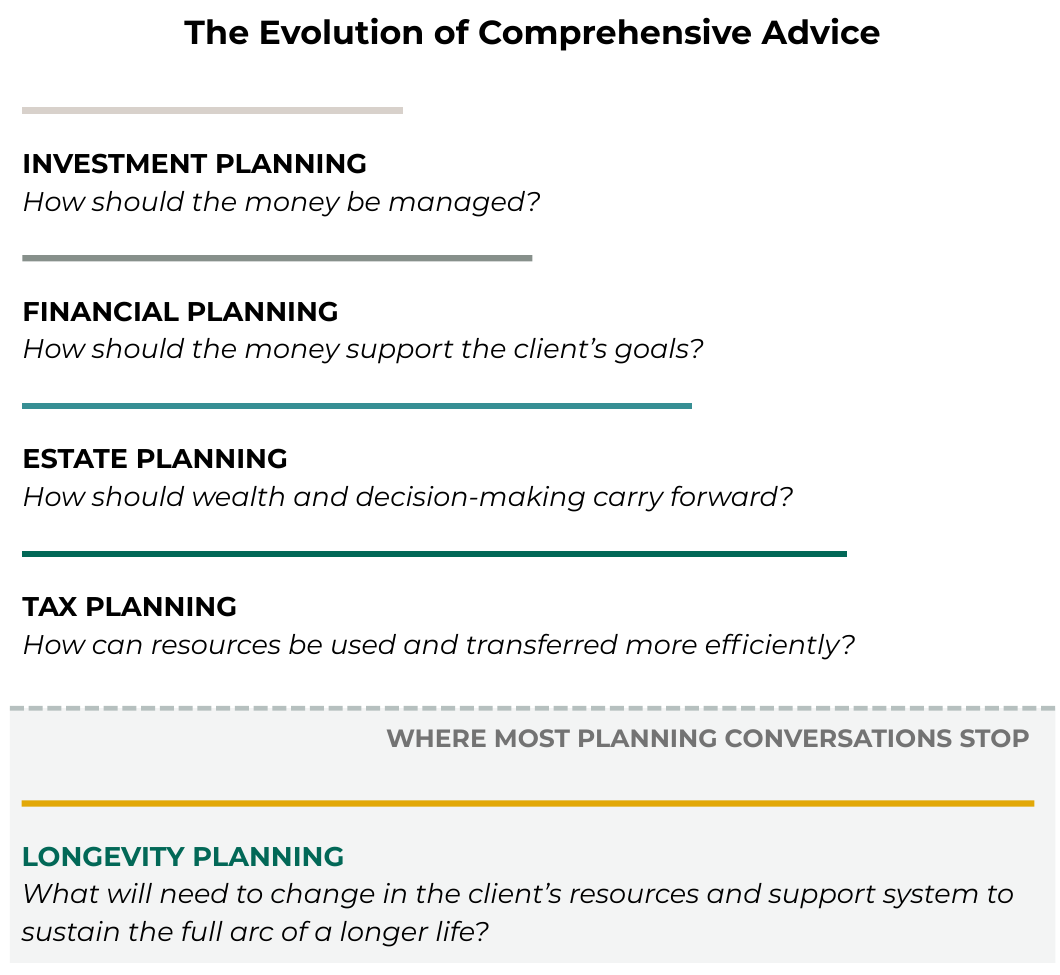
This is not a departure from financial planning, in fact it is its next evolution. Retirement Planning asks: Will the money last? Longevity Planning asks: What will the money need to support across the full arc of a longer life?
That means treating care needs, housing decisions, family readiness, cognitive risk, legal preparation, and legacy as planning variables rather than external events. It means helping clients prepare for questions such as: Where do I want to live as I age, and what would need to be true for me to remain there? Who is likely to help me, and what burden could that place on them? What happens if my spouse needs care? What happens if I do? Who can make decisions if I cannot? Does my family know what I want? Are the right legal and practical structures in place? What do I want to preserve, pass on, or make easier for the people I leave behind?
And, critically, how should the answers to these questions change the financial plan today? Longevity Planning is proactive. It helps clients understand their risks, identify gaps, take action, engage family members, and prepare for the realities they are likely to face across a longer life. It does not require advisors to predict exactly what will happen. No one can. It requires them to understand the range of likely possibilities well enough to help clients take action against the risks they can influence.
The outcome is greater confidence: confidence to spend, confidence to give, and confidence to live. But planning alone is not enough. Because eventually, life happens.
Care Coordination: The Just-in-Time Support Mechanism
A diagnosis arrives. A parent is discharged from the hospital. A spouse begins repeating questions. A client can no longer safely remain at home. A family disagrees about what should happen next. A caregiver reaches a breaking point. At these moments, clients do not need another projection. They need help. This is the role of Care Coordination.
If Longevity Planning is proactive, Care Coordination is just in time. It gives clients and families access to informed guidance and trusted expertise as they navigate experiences that are often confusing, complex, and emotional. That may include helping the family understand the situation, identify immediate priorities, evaluate options, engage trusted specialists, coordinate across providers, and determine what needs to happen next. The advisor remains connected to the client and the financial implications without becoming the care expert.
bQuest: The Missing Infrastructure
Until now, delivering this model has been difficult to scale. An advisor can ask better questions. A firm can build a list of local resources. A planning team can try to help when a client calls in crisis. But without a structured planning framework, specialized expertise, and trusted care infrastructure behind the advisor, the experience remains dependent on the individual advisor’s knowledge, time, and geography.
bQuest was built to provide the infrastructure financial advisors need to deliver Longevity Planning and Care Coordination at scale. The bQuest Care Intelligence Platform gives firms a turnkey way to embed these capabilities directly into the advisor-client experience. It helps advisors and clients look ahead, identifying gaps and preparing across the care, housing, family, legal, cognitive, and legacy considerations that may shape the decades ahead.
And when life happens, bQuest provides just-in-time guidance and access to trusted specialists who can help clients and families navigate what comes next. The advisor does not become the care expert. The advisor becomes the trusted professional who helps the client prepare for what is ahead, and ensures the client and family know where to turn when it arrives.
For advisory firms, this creates the opportunity to deliver a fundamentally different client experience: a structured way to help clients prepare for longer lives, a repeatable process for identifying risks before they become crises, a clearer understanding of the future claims the financial plan may need to support, and a trusted infrastructure of specialized expertise that activates when clients need help.
It also gives advisors a way to deliver tangible value across decades of a client’s life and through the moments their families will remember most. This is the evolution from Retirement Planning to Longevity Planning. Clients gain greater confidence to spend, to give, and to live. Families are better prepared before a crisis. Advisors can deliver meaningful support without becoming the care coordinator. Firms deepen relationships across generations. And the financial plan becomes more connected to the life it was designed to support.
The industry has spent decades helping clients answer one question: Will my money last? The next generation of planning must help them answer a bigger one: Will my resources, and the people and support around me allow me to live the life I want across all the years ahead?
Research and Source Notes
Practitioner Interviews and Contributions
Russ Hill — Former CEO of Halbert Hargrove and author of Optimizing Longevity. Interview and planning framework discussion, including the consumption paradox, longevity risk, and approaches to helping clients understand the relationship between resources and future claims.
Tom West — Long-term care planning specialist whose work supporting advisors and families at SEIA has informed his writing through Age Against the Machine. Published writings and practitioner case examples, including care coordination, emotional timing, cognitive change, and the lived realities of family caregiving.
Frank McAleer — Practitioner whose work at Raymond James and currently Key Financial, Inc. included building and supporting longevity resource networks for financial advisors. Interview and practitioner observations regarding advisor adoption, client engagement, resource networks, and the “return on empathy.”
Research Sources
• Stanford Center on Longevity, The New Map of Life
• Stanford Center on Longevity, Sightlines Project
• U.S. Census Bureau, 2030 demographic projections and Baby Boomer population data
• Ken Dychtwald and Age Wave research and public commentary on longevity and retirement